Treatment Options
Addiction Detox UK: Safety, Settings and Next Steps
By Craig Bilton, Addiction specialist · 11 August 2026 · 19 min read

If you are dependent on alcohol, benzodiazepines, opioids or another prescribed medicine, do not make a sudden change based only on information online. Speak to a doctor, prescriber or specialist treatment service. Call 999 or go to A&E for a seizure, severe confusion, hallucinations, collapse, severe breathing difficulty, chest pain, extreme agitation, suspected overdose or immediate risk of suicide or serious self-harm. Insight Recovery Network is not a regulated healthcare provider, emergency service or medical detox service. We do not diagnose, prescribe or provide medical detox.
Key takeaways
- Detox manages withdrawal; it does not by itself treat the psychological, social and behavioural drivers of addiction.
- The safest setting is chosen through assessment, not by preference, price or the promise of a rapid detox.
- Alcohol and benzodiazepine withdrawal can become medically dangerous. Dependence-forming medicines should not usually be stopped abruptly.
- Opioid withdrawal is not usually life-threatening in a healthy adult, but dehydration, co-occurring illness and loss of tolerance create important risks, including overdose after relapse.
- Cocaine, other stimulant and cannabis withdrawal usually require supportive and psychological care rather than a substitute medicine, but severe depression, psychosis or suicide risk needs urgent assessment.
- Community, residential and specialist inpatient withdrawal services provide different levels of monitoring. A residential setting is not automatically the same as a specialist medical inpatient unit.
- Continuing treatment and a relapse-prevention plan should be agreed before detox ends.
Table of contents
- What addiction detox means
- Detox, stabilisation and recovery: the difference
- Who should have a detox assessment?
- How withdrawal differs by substance
- What a detox assessment should cover
- Community, residential or inpatient detox?
- What happens before, during and after detox
- Can addiction detox be done at home?
- Choosing a detox provider in the UK
- Practical steps to take now
- Guidance for families
- Why aftercare matters
- When to seek professional or emergency help
- Frequently asked questions
What addiction detox means
Detoxification, usually shortened to detox, is the process of managing withdrawal as a substance or medicine leaves the body and the person stops or reduces use. In clinical care, detox is not simply “getting everything out of the system”. It is an active treatment process that may include assessment, prescribed medication, monitoring, symptom management, nutrition, hydration, psychological support and a plan for what follows.[2][3]
The word is used loosely online. A commercial “cleanse”, sauna, supplement, intravenous drip or very short retreat is not equivalent to evidence-based withdrawal management. The important questions are whether dependence is present, which complications are possible, who is clinically responsible, what monitoring is available and how rapidly care can escalate if the person's condition changes.
Some people do not need a formal medical detox. For example, a person using cocaine or cannabis may need structured support to stop, manage sleep or mood changes and address craving, without needing a substitute medicine. Someone with alcohol dependence, long-term benzodiazepine use or opioid dependence may need a medically supervised plan. The same label therefore covers very different clinical situations.
Detox, stabilisation and recovery: the difference
These terms are related but should not be treated as interchangeable.
Stabilisation aims to reduce immediate risk and establish a safer, more predictable pattern. In opioid treatment, for example, a person may be stabilised on opioid substitution treatment rather than immediately moving towards abstinence. In an acute hospital, the priority may be to treat overdose, injury, infection or severe withdrawal before any planned detox decision is made.[2][4]
Detox manages the withdrawal phase. Its aim is to help a person reduce or stop safely, with discomfort and complications monitored and treated appropriately.
Addiction treatment addresses the wider condition. It may include motivational work, psychological therapy, medication where indicated, family support, physical and mental healthcare, mutual aid, recovery planning and practical help with housing, work, finances or relationships.
Recovery is the longer process of building safety, health, connection and a sustainable life. Abstinence may be an important goal, but detox alone does not create the routines, coping skills and support that protect it.
This distinction matters because a successful withdrawal can be followed by rapid relapse if nothing changes around the person. For opioids, a return to a previously tolerated amount after abstinence can cause overdose because tolerance has fallen.[2]
Who should have a detox assessment?
A professional assessment is advisable whenever there may be physical dependence, previous difficult withdrawal, use of several substances, significant physical or mental-health problems, pregnancy, safeguarding concerns or uncertainty about what has been taken.
Seek assessment before stopping or sharply reducing if any of the following apply:
- daily or near-daily alcohol use with shaking, sweating, nausea, anxiety or a need to drink to feel normal
- a previous withdrawal seizure, delirium tremens, hallucinations or severe confusion
- regular benzodiazepine or Z-drug use, particularly at a high dose or over a long period
- opioid dependence, including heroin or non-medical use of prescription opioids
- use of methadone, buprenorphine or another prescribed dependence treatment
- several substances used together, especially alcohol, opioids and sedatives
- significant liver, heart, respiratory, neurological or other physical illness
- depression, psychosis, severe anxiety, self-harm or suicide risk
- pregnancy or the possibility of pregnancy
- an unsafe or unstable home, limited support, homelessness or risk from another person
- previous detox attempts followed by rapid relapse or overdose
- uncertainty about the substance, strength, dose or contamination.
An online questionnaire can help organise information and indicate that a fuller assessment is needed, but it cannot diagnose dependence, predict every complication or prescribe a withdrawal regimen.
How withdrawal differs by substance
Alcohol
Alcohol withdrawal may begin after a dependent person stops or substantially reduces drinking. Symptoms can include tremor, sweating, nausea, anxiety, poor sleep, agitation and a raised pulse. Severe withdrawal can involve seizures, hallucinations, delirium tremens and Wernicke's encephalopathy. UK guidance therefore recommends planned, medically assisted withdrawal for people who need it, with the setting and monitoring matched to severity and complexity.[1][3][5]
Community withdrawal can be appropriate after assessment when risks are manageable and reliable support and monitoring are available. Specialist inpatient care may be considered for severe dependence, a history of withdrawal seizures or delirium tremens, high risk of Wernicke's encephalopathy, important physical or psychiatric illness, multiple-substance dependence or inadequate safety at home.[1][5]
Do not use an article to choose your own alcohol-withdrawal medication or dose. Prescribing requires clinical assessment, attention to liver health, other medicines and regular review.
Opioids
Opioid withdrawal can cause sweating, agitation, muscle and abdominal pain, nausea, vomiting, diarrhoea, insomnia and strong craving. It is often extremely distressing. Complications may arise through dehydration, co-occurring illness, use of other substances or attempts to relieve symptoms without medical advice.
NICE states that opioid detox should be a joint, informed decision with continued support and monitoring. Methadone or buprenorphine are first-line medicines in opioid detoxification, with the regimen chosen by a qualified prescriber according to dependence, stability, other substance use, health and setting. Ultra-rapid detoxification under general anaesthesia or heavy sedation should not be offered.[2]
The major post-detox risk is loss of tolerance. If a person returns to opioids, an amount previously used may now cause fatal overdose. Naloxone access, overdose education and continuing treatment should be discussed as part of the plan.[2][4]
Benzodiazepines, Z-drugs and other dependence-forming medicines
Physical dependence can develop even when a medicine has been taken as prescribed. It is not the same thing as addiction, although the two can coexist. NICE advises against abrupt discontinuation of opioids, benzodiazepines, gabapentinoids, Z-drugs or antidepressants except in exceptional medical circumstances. Withdrawal is usually planned as a slow, stepwise reduction that can be adjusted to the person's response.[6]
The benzodiazepine addiction and dependence guide explains this distinction, urgent risks and the questions a medicine review should cover.
Someone considering a reduction should speak to the original prescriber, GP or another qualified clinician. The plan should consider dose, duration, previous withdrawal, concurrent medicines, physical and mental health, the original condition and the person's circumstances. This article intentionally does not provide a taper schedule because a generic schedule can be unsafe.
Cocaine and other stimulants
There is no routine substitute medicine for cocaine dependence comparable with opioid substitution treatment. After heavy or repeated stimulant use, a person may experience fatigue, sleep disturbance, increased appetite, low mood, irritability, poor concentration and craving. Supportive care, risk assessment and psychosocial treatment are central.[4][7]
The “crash” should not be dismissed. Severe depression, suicidal thinking, psychosis, extreme agitation or prolonged inability to sleep needs prompt clinical assessment. Chest pain, a seizure, collapse, stroke symptoms or severe breathing difficulty after recent use is a medical emergency.
Cannabis
Stopping frequent cannabis use can be followed by irritability, anxiety, sleep disturbance, vivid dreams, reduced appetite, restlessness and craving. These symptoms are usually managed with information, sleep and routine support, psychological strategies and treatment of any co-occurring mental-health needs. Severe anxiety, psychosis, suicide risk or inability to care for oneself requires urgent professional assessment.[4][7]
More than one substance
Combined use changes the risk. Alcohol and benzodiazepines can both depress the central nervous system; opioids combined with alcohol or sedatives increase overdose risk. A person may also increase alcohol or another drug to cope with withdrawal. NICE recommends assessing dependence on other substances and deciding carefully whether withdrawals should occur separately, concurrently or after stabilisation.[2]
Do not assume that the substance causing the greatest concern is the one that should be stopped first. That is a clinical sequencing decision.
What a detox assessment should cover
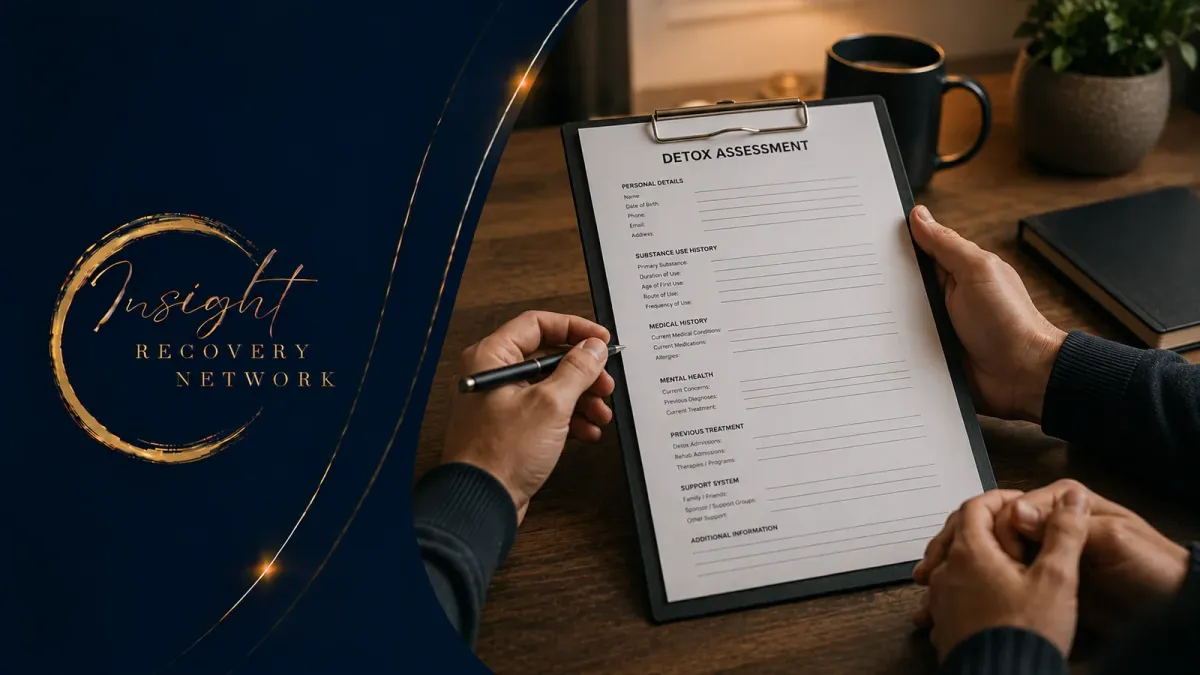
A good assessment connects the substance history with the whole person. It should usually explore:
- what is being used, how often, in what amount and by which route
- the time of the last use and whether the pattern is changing
- prescribed, over-the-counter and non-prescribed medicines
- alcohol and other substances that may affect withdrawal or overdose risk
- signs of current intoxication or withdrawal
- previous withdrawal, seizures, delirium, hallucinations, overdose and detox attempts
- current physical health, including relevant examination or tests where indicated
- mental health, self-harm, suicide risk, psychosis, cognition and sleep
- pregnancy and reproductive health where relevant
- nutrition, hydration and risk of vitamin deficiency
- home safety, housing, caring responsibilities and available support
- safeguarding, domestic abuse or exploitation concerns
- motivation, goals and preferences
- access to transport, medication supervision and urgent care
- what treatment and recovery support will follow detox.
Screening tools and tests can support clinical judgement but should not replace it. Information may need to be confirmed when the substance or level of tolerance is uncertain.[2][5]
Community, residential or inpatient detox?
The least intensive setting is not always the safest, and the most intensive setting is not automatically the best. The purpose of assessment is to match clinical capability and support to the person's actual risks.
| Setting | May be suitable when | Important limitations or checks |
|---|---|---|
| Community-based medically assisted withdrawal | Risks are assessed as manageable; the person can engage with monitoring; medicines and support can be provided safely; the home environment and support are adequate | Confirm review frequency, named clinical responsibility, medication arrangements, out-of-hours escalation and what happens if symptoms worsen |
| Residential medically assisted withdrawal | The person needs a substance-free, structured environment or lacks adequate social support, while clinical risks remain within the service's capability | Residential care is not automatically a specialist inpatient medical unit; check staffing, prescribing, overnight monitoring, transfer pathways and regulated activity |
| Specialist inpatient withdrawal | Severe dependence, previous serious complications, complex physical or mental-health needs, multiple-substance dependence or other risks require specialist observation and rapid clinical response | Confirm admission criteria, medical and nursing cover, emergency capability, pharmacy arrangements and discharge planning |
| Acute hospital or emergency care | There is severe withdrawal, overdose, seizure, delirium, acute injury, serious illness, pregnancy-related concern or another urgent medical problem | The emergency problem comes first; planned addiction treatment and follow-up should be arranged once the person is stable |
The 2025 UK clinical guidelines for alcohol treatment distinguish specialist inpatient units from residential withdrawal settings. A comfortable bedroom, private room or 24-hour staff presence does not by itself establish that a service can manage complex withdrawal.[5]
An online recovery programme is not a medical detox service. It may support motivation and recovery planning before admission, or continuing recovery after a person is medically stable, but it should not replace prescribing, physical monitoring or emergency care.
What happens before, during and after detox
Before detox
The team should explain the expected process, benefits, limits and risks in language the person understands. A plan should identify the setting, responsible clinician, medicines if indicated, monitoring, practical arrangements, emergency pathway and continuing treatment. The person should have an opportunity to ask questions and involve a trusted family member or supporter where appropriate and consented.
Preparation may include physical observations, blood tests or other investigations, medicine reconciliation, arrangements for thiamine in alcohol treatment, overdose education and naloxone for opioid risk, and plans for children, work, transport or caring responsibilities. The exact requirements depend on the substance and clinical picture.[2][5]
During detox
Monitoring should be proportionate to risk. Staff may assess symptoms, pulse, blood pressure, temperature, hydration, orientation, sleep, mood and medicine response. The plan should change if withdrawal is more severe than expected or new information emerges.
Prescribed medication should follow a clinical protocol and be reviewed by qualified professionals. Taking extra sedatives, alcohol, opioids or unreported medicines can alter the risk and must be disclosed. Honest disclosure is a safety issue, not a moral test.
After detox
Discharge should not be the first time aftercare is discussed. The plan may include psychological treatment, medication to support relapse prevention where clinically appropriate, online or community recovery support, family work, peer support, physical and mental healthcare, housing or employment help, and clear action if craving or relapse occurs.[1][2][4]
For opioids, reduced tolerance and overdose prevention need explicit attention. For alcohol, continuing treatment may include psychosocial support and, after medical assessment, relapse-prevention medication. For prescribed medicines, follow-up may need to continue while symptoms settle or the reduction plan changes.[1][2][6]
Substance-specific withdrawal and detox guides
The broad principles on this page do not replace substance-specific decisions. Use the relevant guide to prepare for a conversation with a qualified service:
- Alcohol detox and withdrawal, including medically assisted withdrawal and urgent warning signs
- Benzodiazepine withdrawal, including the difference between prescribed dependence and addiction
- Opioid detox and withdrawal, including maintenance treatment, reduced tolerance and overdose prevention
- Cocaine withdrawal, including the crash, depression and psychological support
- Ketamine withdrawal, including the separate medical pathway for bladder, urinary or abdominal harm
- Detox vs rehab, explaining how withdrawal management and continuing addiction treatment fit together.
These pages do not provide medication schedules or individual clearance to stop. Alcohol, benzodiazepine and opioid decisions require particular care, and combined use may change the safest sequence or setting.
Can addiction detox be done at home?
Some planned withdrawals are delivered in the community and may take place while a person remains at home. That is different from deciding to stop suddenly without assessment, medication oversight or monitoring.
A home or community plan may be inappropriate when there is a history of severe withdrawal, significant physical or psychiatric illness, multiple-substance dependence, pregnancy, uncertain tolerance, high self-harm or overdose risk, an unsafe home, limited reliable support or difficulty attending reviews. The criteria vary by substance and service.[1][2][5]
Avoid these common shortcuts:
- using someone else's detox medication
- buying sedatives or opioid substitutes online
- estimating a taper from an internet forum
- drinking alcohol to treat withdrawal from another substance
- combining medicines to force sleep
- choosing “rapid” detox because it promises the shortest stay
- assuming a friend can manage seizures, delirium or overdose at home
- booking travel before clinical suitability and continuity of care are clear.
If cost, privacy, work or family duties make residential care difficult, explain those constraints during assessment. A clinician or treatment navigator may be able to compare safer community, outpatient, residential or inpatient options without minimising risk.
Choosing a detox provider in the UK
Whether care is NHS-funded or private, ask what the service is clinically equipped to do. Useful questions include:
- Who completes the assessment and who holds clinical responsibility?
- Which substances and levels of complexity can the service safely manage?
- Is prescribing provided directly, through another provider or not at all?
- What medical and nursing cover is available during the day and overnight?
- How are withdrawal symptoms monitored and documented?
- What happens if the person becomes confused, has a seizure or needs hospital care?
- How does the service manage physical illness, mental-health risk and multiple substances?
- Which regulated activities does the provider deliver, and which regulator applies?
- What is included in the quoted price, including assessment, medicines, tests, transfers and aftercare?
- What continuing treatment begins during or immediately after withdrawal?
- How are family communication, consent and confidentiality handled?
- What is the plan if admission is delayed or the person relapses before arrival?
IRN's treatment-placement role is to help people compare suitable providers and admission routes after assessment. It does not replace the admitting service's medical assessment, prescribe detox medication or guarantee that a particular setting will accept a person.
Practical steps to take now
- Do not make an abrupt change if dependence may be present. Contact a GP, prescriber, NHS drug and alcohol service or qualified addiction clinician.
- Write down the current pattern. Record substances, prescribed medicines, approximate amounts, frequency, last use and any recent change. Do not delay urgent help to make the list perfect.
- Record previous complications. Include seizures, hallucinations, delirium, overdose, severe vomiting, self-harm, hospital admissions and previous detox attempts.
- Be open about combined use. Alcohol, sedatives, opioids and stimulants can alter the plan even when one substance feels like the main problem.
- Identify immediate risks. Consider suicidal thoughts, psychosis, pregnancy, serious illness, unsafe housing, domestic abuse and caring responsibilities.
- Arrange an assessment. Ask which professional will decide the setting and how quickly it can occur.
- Plan the period after withdrawal. Book follow-up, organise transport and support, reduce access to substances where safe, and agree what to do if craving or relapse occurs.
- Keep emergency directions separate from commercial decisions. If severe symptoms occur, use 999 or A&E rather than waiting for a provider callback.
Guidance for families
A family member can help with information, practical arrangements and continuity, but should not be expected to act as a detox nurse.
Choose a time when the person is not heavily intoxicated and describe specific observations without labels or threats. For example: “You were shaking this morning and needed a drink before work. I am worried that stopping suddenly might be unsafe. Can we arrange an assessment today?”
With the person's consent, share an accurate history of previous withdrawal, prescribed medicines, other substances, mental-health concerns and recent changes. Ask the assessing service what warning signs require emergency help and what the family should not attempt at home.
Set boundaries around money, driving, childcare, aggression and substances in the home. If children or vulnerable adults may be at risk, safeguarding takes priority over keeping the problem private. Families also deserve support for their own wellbeing, sleep, anxiety and decision-making.
If the person refuses help, you can still seek professional advice, prepare an emergency plan and avoid supplying unprescribed medication or alcohol as a withdrawal treatment.
Why aftercare matters

Withdrawal may create a short period of abstinence, but the original triggers, habits, relationships and health needs remain. Early recovery can also involve disrupted sleep, low mood, anxiety, craving and a sudden loss of the routines built around substance use.
Continuing care should be matched to need. It may include structured online recovery, community treatment, residential rehabilitation, one-to-one therapy, group work, medication, family support, peer support and practical recovery planning. Online care may be particularly useful after medical stability when the person can engage safely at home, but it is not appropriate as the only response to acute withdrawal or unmanaged risk.
A relapse-prevention plan should identify warning signs, high-risk situations, people to contact, overdose precautions, medicine arrangements and the quickest route back to treatment. A lapse is a reason to reassess safety, not proof that detox or recovery has “failed”.
When to seek professional or emergency help
Arrange prompt professional assessment when dependence may be present, withdrawal has occurred before, several substances are involved, prescribed medicines are being reduced, physical or mental health is unstable, pregnancy is possible, the home is unsafe or previous detox has not led to stable recovery.
Call 999 or go to A&E for:
- a seizure
- severe confusion, disorientation or hallucinations
- collapse, loss of consciousness or suspected overdose
- severe breathing difficulty, blue or grey lips, chest pain or stroke-like symptoms
- extreme agitation, violent behaviour or inability to keep the person safe
- persistent vomiting with marked drowsiness or signs of serious dehydration
- immediate danger of suicide or serious self-harm.
For urgent medical help that is not immediately life-threatening, use NHS 111. Do not drive someone yourself if they are unconscious, having a seizure, severely confused or may deteriorate on the journey.
A measured next step
If you are unsure whether withdrawal may need medical support, a confidential recovery assessment can organise the history, identify risk flags and clarify which questions to take to a GP, prescriber, NHS treatment service or detox provider. It is not a diagnosis or emergency service.
When residential or specialist detox may be needed, assessment-led treatment placement can help compare provider capability, admission criteria, medical cover and aftercare. The admitting clinician must still confirm suitability.