Treatment Options
How to Choose the Right Private Rehab Centre in the UK
By Craig Bilton, Addiction specialist · Updated 5 October 2026 · 18 min read
Choose a private rehab by checking whether it can meet the person's assessed needs safely. Compare medical and detox capability, staff qualifications, regulation, the treatment programme, total written costs and aftercare. Ask what the centre cannot manage, and obtain answers before paying a deposit or arranging travel.
What to check before booking
| Decision | Ask the provider | What to obtain |
|---|---|---|
| Safety and suitability | Can you manage the person's withdrawal, medical and mental-health needs? | An assessment and a clear explanation of any limits or onward referrals. |
| Total cost | Are detox, medication, tests, family work and aftercare included? | A dated, itemised quote, payment terms and cancellation policy. |
| Programme and people | Who provides treatment, and what are their qualifications? | Named roles, a programme timetable and the relevant registration details. |
| Leaving treatment | Who supports the person after discharge, and for how long? | A continuing-care plan with named responsibilities and any additional fees. |
IRN helps you compare options. Medical assessment, detox and treatment are provided by the appropriate healthcare services.
Talk to Craig about choosing rehabWhatsApp is for non-urgent enquiries. Start with a brief question; you do not need to send a full history.
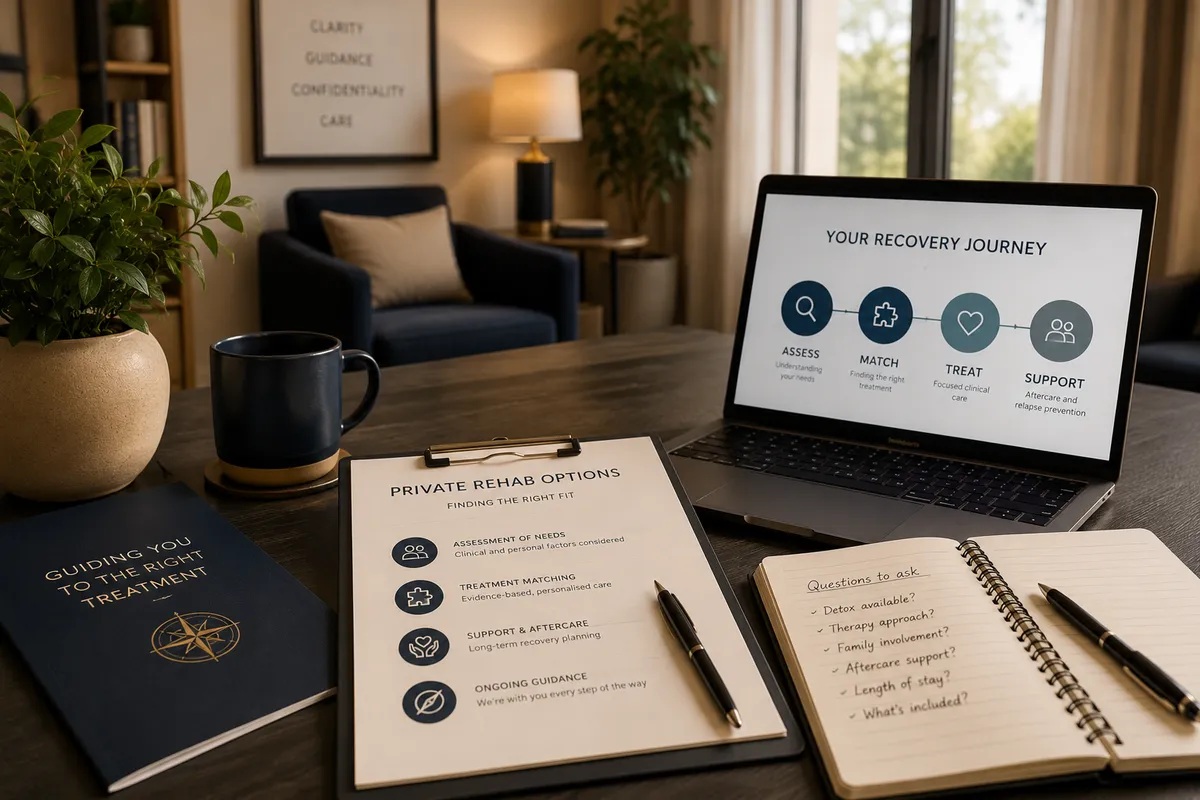
The right private rehab centre is the one that can safely meet the person's assessed needs, not necessarily the closest, most expensive or most luxurious. Check detox capability, clinical leadership, therapy, co-occurring mental-health support, family involvement, costs, aftercare, regulation and what the service cannot manage before committing.
Choosing private rehab in the UK can feel overwhelming, especially when the situation has become urgent or emotionally charged. For many individuals and families, the decision is not simply about finding a treatment centre. It is about safety, trust, cost, confidentiality, hope, and fear.
You may be wondering whether things are "bad enough" for residential rehab. You may be trying to compare private rehab in the UK while under pressure from family members, employers, partners, or the person struggling. You may also be asking a difficult question: how do I choose the right private rehab centre in the UK when every website seems to promise the same thing?
The truth is that choosing the right rehab centre requires more than looking at photographs, prices, location, or availability. A good placement should be based on clinical need, risk, substance use history, mental health, family dynamics, previous treatment experiences, and the level of support required after discharge.
Private addiction treatment can be life-changing when it is properly matched to the person. But the wrong setting, the wrong level of care, or a rushed decision can create disappointment, financial strain, and unnecessary risk.
This guide will help you understand what to look for, what questions to ask, and when professional rehab placement guidance may help.
Private Rehab Is Not One-Size-Fits-All
One of the most common mistakes people make when looking for private rehab is assuming that all treatment centres offer roughly the same service. They do not.
Residential rehab centres vary significantly in their clinical structure, therapeutic model, staff experience, detox provision, mental health support, family involvement, aftercare planning, and overall philosophy of care.
Some centres are highly clinical and structured. Others are more therapeutic-community based. Some specialise in alcohol rehab UK, drug rehab UK, trauma, dual diagnosis, executive treatment, or family work. Some provide medically supervised detox onsite, while others require detox to be arranged elsewhere before admission.
When choosing a private rehab centre, it is important to understand the difference between a comfortable environment and a clinically suitable treatment setting. A beautiful building may feel reassuring, but the real value lies in the quality of assessment, treatment planning, therapy, detox safety, relapse prevention, and aftercare.
A strong private rehab programme should be able to explain:
- What treatment model they use
- Who leads the clinical programme
- How detox is managed
- What therapy is provided
- How mental health support is integrated
- How family support is included
- What happens after discharge
- How relapse prevention is developed
- How outcomes and progress are reviewed
The best private rehab UK option is not necessarily the most expensive, the closest, or the one with the most polished marketing. It is the one that is most appropriate for the person's actual needs.
Understand What the Person Actually Needs
Before choosing a private residential rehab programme, it is important to step back and ask: what does this person actually need?
Addiction treatment UK options should never be chosen purely on urgency or emotion. Urgency matters, especially when there is risk, but a good decision still requires proper assessment.
The right rehab depends on several factors.
Substance Use and Withdrawal Risk
Alcohol dependence, benzodiazepine dependence, and some forms of prescription medication misuse may involve withdrawal risks that require medical assessment. In these situations, it is essential to ask whether medically supervised detox is available and whether the centre is properly equipped to manage withdrawal safely.
For someone with alcohol dependence, the question is not only "do they need rehab?" It may also be "do they need detox before therapy can begin safely?"
Mental Health and Dual Diagnosis
Many people entering private addiction treatment are not only dealing with alcohol, cocaine, drugs, gambling, or compulsive behaviour. They may also be struggling with anxiety, depression, trauma, ADHD, burnout, grief, emotional dysregulation, or relationship breakdown.
This is often referred to as dual diagnosis, where addiction and mental health difficulties exist together. A rehab centre that only focuses on stopping the substance or behaviour, without understanding the emotional and psychological drivers beneath it, may miss important parts of the recovery process.
Good treatment should consider both the addictive behaviour and the wider mental health picture.
Previous Treatment History
Has the person tried to stop before? Have they attended outpatient counselling, mutual aid groups, detox, rehab, therapy, or coaching? Have there been repeated relapses?
Repeated relapse does not mean someone is hopeless. It usually means the treatment plan needs to be more realistic, more structured, or better matched to the person's underlying needs.
Home Environment and Family Dynamics
A person may be highly motivated while inside treatment, but if they return to the same chaotic environment without aftercare, boundaries, structure, or family support, the risk of relapse can increase.
Family dynamics matter. Sometimes the home environment is supportive. Sometimes it is strained, enabling, emotionally volatile, or unsafe. A good rehab placement should consider what the person is returning to, not just what happens during admission.
Motivation and Readiness
Some people enter rehab highly motivated. Others arrive ambivalent, defensive, frightened, or under pressure from family. This does not automatically mean treatment will fail, but it does mean the programme needs to be skilled in engagement, resistance, denial, shame, and ambivalence.
A strong rehab centre should understand that motivation is not fixed. It can develop when the person feels safe, challenged, understood, and properly supported.
Questions to Ask Before Choosing a Private Rehab Centre
If you are wondering what questions you should ask before entering a private residential rehab programme, the following list is a good place to start.
1. Is Medically Supervised Detox Available if Needed?
If alcohol, benzodiazepines, opioids, or prescription medication are involved, detox safety must be taken seriously. Ask whether detox is provided onsite, who oversees it, what medical support is available, and how risks are assessed before admission.
2. Who Leads the Clinical Programme?
A credible rehab centre should be able to explain who has clinical oversight. Ask about the clinical lead, their qualifications, experience, and involvement in treatment planning.
3. What Qualifications and Experience Do the Therapy Team Have?
It is reasonable to ask who will be delivering therapy and what training they have. Addiction treatment requires experience, emotional maturity, and clinical understanding. The quality of the team matters.
4. Is There Individual Therapy as Well as Group Work?
Group therapy can be powerful, but many people also need individual therapy to explore trauma, grief, shame, relationship patterns, mental health, or personal relapse triggers. Ask how often individual sessions are provided and whether they are included in the cost.
5. How Is Dual Diagnosis Supported?
If the person has anxiety, depression, trauma, ADHD, burnout, or other mental health difficulties, ask how these are assessed and supported. A centre does not need to promise to treat everything, but it should be honest about what it can and cannot safely manage.
6. Is Family Work Included?
Addiction affects the whole family system. Family support and intervention guidance can help improve communication, boundaries, education, and planning for discharge. Ask whether family sessions, updates, or structured family involvement are included.
7. What Does Aftercare Look Like?
Rehab should not end at discharge. Ask what aftercare is provided, how long it lasts, whether it is included in the price, and whether there is a clear plan for ongoing support.
8. How Is Relapse Prevention Planned?
Relapse prevention should be more than a worksheet completed at the end of treatment. Ask how the centre helps clients identify triggers, warning signs, high-risk situations, coping strategies, support systems, and routines for life after rehab.
9. What Happens if the Person Wants to Leave Early?
This is an important question. Many people experience moments in treatment where they want to leave. Ask how the team manages this, how families are informed, and what support is offered during periods of doubt or distress.
10. What Is Included in the Cost?
Private rehab costs can vary significantly. Ask what is included and what may be charged separately. Clarify detox, therapy, psychiatric input, medication, family work, transport, aftercare, and extended stay options.
11. How Is Confidentiality Handled?
Confidential rehab guidance and treatment are especially important for professionals, public-facing individuals, executives, parents, and those worried about stigma. Ask how information is protected, who receives updates, and what consent is required.
Insight Recovery Network provides confidential rehab placement guidance for individuals and families. We help clarify what is needed and identify treatment routes that are clinically appropriate, without pressure or sales tactics.
Speak to Insight Recovery NetworkWarning Signs That a Rehab May Not Be the Right Fit
Most rehab providers want to help, but not every centre will be right for every person. Some warning signs should make you pause before making a decision.
Vague Answers About the Programme
If a centre cannot clearly explain its treatment model, daily structure, therapy provision, clinical leadership, or aftercare, this is a concern. You should not be left guessing what the person is actually paying for.
Overly Aggressive Sales Tactics
Urgency is sometimes real, but pressure-based selling can lead families into rushed decisions. Be cautious if you feel pushed to pay immediately without proper assessment or explanation.
No Clear Clinical Leadership
A rehab centre should have identifiable clinical oversight. If it is unclear who is responsible for treatment planning, risk management, detox decisions, or therapeutic quality, ask more questions.
Little or No Aftercare Planning
Rehab is only one stage of recovery. A centre that gives little attention to aftercare may not be preparing the person properly for life after discharge.
No Proper Assessment Before Admission
A credible provider should want to understand the person before admission. This includes substance use, mental health, risk, medication, physical health, previous treatment, and current circumstances.
Poor Explanation of Detox Safety
If detox may be required, vague reassurance is not enough. The centre should clearly explain how detox is assessed and managed.
Accommodation Presented as Treatment
Comfort matters, but accommodation is not treatment. Be cautious of programmes that focus heavily on facilities, food, scenery, or luxury, but say very little about therapy, clinical care, relapse prevention, or aftercare.
Promises of Guaranteed Outcomes
No ethical provider can guarantee recovery. Treatment can create the conditions for change, but recovery also depends on engagement, honesty, ongoing support, accountability, and continued work after discharge.
UK-Based Rehab vs Rehab Abroad
Some people prefer private rehab UK options because they want to remain close to home, family, work, or familiar systems. This can be appropriate, especially where family involvement, legal responsibilities, childcare, or local aftercare are important.
Others benefit from stepping away from their usual environment. Rehab abroad can sometimes offer privacy, distance from familiar triggers, cost differences, and a psychological reset. For some clients, particularly those who feel trapped in familiar routines, this distance can be helpful.
However, treatment abroad should never be chosen purely because it looks attractive or feels like an escape. It still needs to be clinically appropriate. Important questions include:
- Is detox safely managed?
- Are the staff properly qualified?
- Is the programme clinically structured?
- How is family contact handled?
- What happens if risk increases?
- What aftercare is arranged for returning home?
- Are there language, cultural, legal, or travel considerations?
For some people, treatment abroad is a strong option. For others, staying in the UK is safer and more practical. The key is not location alone. The key is suitability. Treatment placement guidance can help you weigh these options clearly.
If Spain is one of the options you are comparing, our rehab in Spain guide covers provider checks, language, travel, itemised costs and returning home. If you are still deciding whether residential care is needed at all, start with the comparison of private rehab alternatives for UK adults, including the limits of online and outpatient support.
Before returning to the UK: agree the handover
Before discharge from rehab abroad, ask the treatment team to agree a practical handover with the person receiving care. Check:
- Who will coordinate follow-up in the UK and when the first contact will happen.
- Which GP, local treatment service or mental-health professional needs a discharge summary, with appropriate information-sharing arrangements.
- Who is responsible for medication review and prescribing after discharge. IRN does not prescribe.
- Where the person will stay, how they will get home and which recovery or peer-support contacts are in place.
- What happens if the person leaves earlier than planned or needs help before the first appointment.
- What aftercare is included in the fee and what requires a separate arrangement.
A written plan should name the people responsible for each next step. Digital tools can support that plan; they do not provide medical care or replace agreed professional follow-up.
For the continuity-planning principles behind this checklist, see the Department of Health and Social Care's alcohol-treatment guidance, sections 14.4.5 and 14.4.6. The checklist adapts those principles to a return from abroad; UK guidance does not regulate overseas providers.
The Role of Family in Choosing Rehab
Families often carry the urgency long before the person struggling is ready to accept help. They may have watched months or years of broken promises, secrecy, emotional distance, financial problems, health concerns, or repeated attempts to stop.
This can create panic. Families may feel they need to act immediately, and sometimes they do. But panic can also lead to decisions based on fear rather than fit.
Family members can help by:
- Gathering accurate information
- Avoiding threats they cannot follow through on
- Setting clear and calm boundaries
- Refusing to minimise the seriousness of the problem
- Not choosing a centre based only on price or availability
- Seeking professional guidance when the person is resistant
- Remembering that support and rescuing are not the same thing
When someone is ambivalent, defensive, or refusing help, family intervention guidance may be useful. A structured, professionally guided conversation can help families communicate concern without chaos, blame, or emotional bargaining.
The aim is not to force someone into treatment. The aim is to create clarity, reduce confusion, and help the person face reality with support.
Why Aftercare and Relapse Prevention Matter
Rehab is not the finish line. It is a concentrated period of stabilisation, education, therapy, and recovery planning. The real test often begins after discharge, when the person returns to normal life.
A strong treatment plan should prepare someone for:
- Daily structure
- Emotional triggers
- Relationship stress
- Work pressure
- Cravings
- Isolation
- Boredom
- Family boundaries
- Sleep and routine
- High-risk situations
- Accountability
- Ongoing therapy or support
Relapse prevention is not simply about avoiding substances or behaviours. It is about learning to recognise the early warning signs that recovery is weakening. These may include dishonesty, isolation, resentment, emotional shutdown, overconfidence, poor routine, secrecy, or drifting away from support.
Insight OS, Insight Recovery Network's digital recovery support system, is designed to help people continue recovery work beyond treatment. It supports daily check-ins, journalling, mood tracking, trigger awareness, relapse prevention planning, recovery wins, and ongoing reflection. Tools like this can help turn relapse prevention from a document into a daily practice.
The best rehab centres understand that discharge planning begins early. Aftercare should not be an afterthought.
When Rehab Placement Guidance Can Help
Trying to choose a rehab centre alone can be difficult, especially when emotions are high and time feels limited. Professional rehab placement guidance can help individuals and families slow the process down enough to make a better decision.
Insight Recovery Network provides confidential rehab placement guidance for people looking at private addiction treatment in the UK or abroad. The role is not to push one option. It is to help clarify what is needed and identify treatment routes that are clinically appropriate.
This may include considering:
- Whether residential rehab is necessary
- Whether detox is required
- Whether mental health support is needed
- Whether the person requires a UK-based or international setting
- Whether family intervention support is appropriate
- What level of aftercare is needed
- Whether online recovery support could form part of the longer-term plan
- What questions should be asked before committing financially
Good guidance can help families avoid rushed placements, poorly matched programmes, and decisions made purely from fear.
FAQ: Choosing Private Rehab in the UK
How do I know if someone needs private rehab?
Someone may need private rehab if their alcohol use, drug use, or addictive behaviour is causing serious consequences and they cannot stop despite wanting to. Warning signs may include repeated relapse, withdrawal symptoms, secrecy, relationship breakdown, work problems, declining mental health, unsafe behaviour, or family crisis. A professional assessment can help determine the right level of care.
Is private rehab better than NHS addiction treatment?
Not always. NHS addiction services can be valuable and accessible, especially for community-based support. Private rehab may be more suitable when there is urgency, withdrawal risk, repeated relapse, complex mental health needs, family crisis, or a need for residential structure and discretion. The right choice depends on the person's needs, risk, and circumstances.
How long should someone stay in residential rehab?
The appropriate length of stay depends on the person's clinical needs, substance use history, mental health, risk level, and recovery goals. Some people benefit from shorter stabilisation periods, while others need longer residential treatment. It is important to ask the rehab centre how they recommend length of stay and how progress is reviewed.
What should I ask before paying for rehab?
Before paying for rehab, ask about detox safety, clinical leadership, therapy provision, staff qualifications, dual diagnosis support, family involvement, aftercare, relapse prevention, confidentiality, total cost, and what happens if the person wants to leave early. Do not rely only on brochures or website claims.
Can Insight Recovery Network help me choose a rehab centre?
Yes. Insight Recovery Network provides confidential rehab placement guidance for individuals and families considering private rehab UK options or treatment abroad. We help clarify needs, ask the right questions, compare suitable routes, and identify treatment options that are clinically appropriate.
Conclusion: Choose Carefully, Not Just Quickly
Choosing a private rehab centre is one of the most important decisions a person or family may make. It is understandable to feel urgency, especially when the situation has become painful, frightening, or unstable. But urgency should not mean rushing into the first available option.
The right rehab should be clinically suitable, transparent, safe, structured, and honest about what it can provide. It should consider detox, therapy, mental health support, family involvement, aftercare, relapse prevention, and the person's life after treatment.
Insight Recovery Network helps individuals and families make sense of the treatment landscape and choose the next step with clarity. If you are unsure where to begin, we can provide confidential rehab placement guidance and help you explore suitable private addiction treatment options in the UK or abroad.
For confidential support, contact Insight Recovery Network to discuss the most appropriate treatment pathway for you or someone you care about. There is no pressure, no obligation, and no need to have everything worked out before getting in touch.
Speak to Insight Recovery Network