Treatment Options
Private Rehab vs NHS Addiction Treatment: What Is the Difference?
By Craig Bilton, Addiction specialist · Updated 5 October 2026 · 15 min read
Start with the level of support needed, then compare access and funding. NHS and locally commissioned services offer routes to addiction support without private treatment fees; funded residential care depends on assessment and local arrangements. Private treatment is paid for separately. Neither route is automatically the right fit for every person.
Compare access, cost and support
| Question | NHS or locally commissioned support | Private treatment |
|---|---|---|
| How do I start? | Contact your GP or local drug and alcohol service; self-referral may be available. | Contact a provider for assessment, availability and a written quote. |
| What will I pay? | Publicly funded support does not carry private treatment fees; residential funding has local criteria. | Fees vary. Confirm detox, medication, tests, accommodation and aftercare separately. |
| Is residential care available? | A residential placement depends on assessed needs, local pathways and funding. | Admission depends on suitability, clinical capacity, availability and payment arrangements. |
| What happens afterwards? | Ask which local services will provide continuing support. | Confirm the duration, provider and cost of aftercare before admission. |
IRN helps you compare options. Medical assessment, detox and treatment are provided by the appropriate healthcare services.
Talk to Craig about treatment optionsWhatsApp is for non-urgent enquiries. Start with a brief question; you do not need to send a full history.
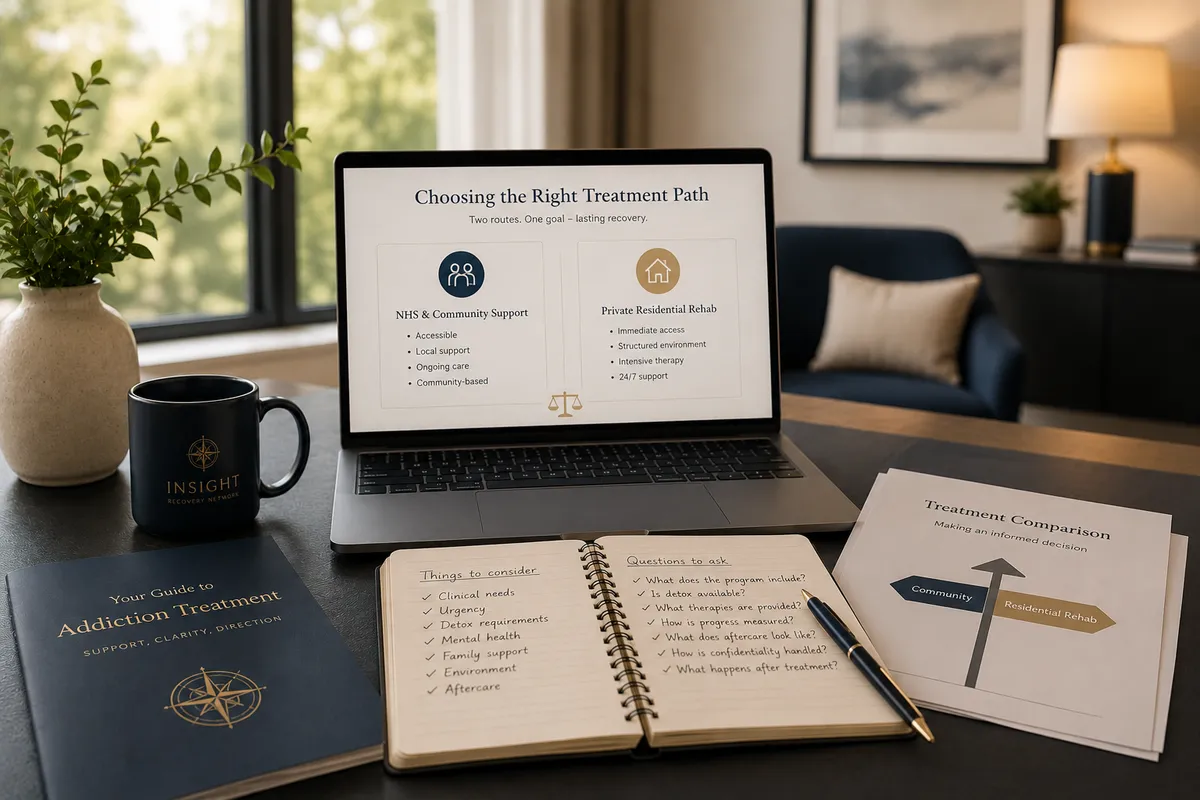
When someone is struggling with alcohol, drugs, prescription medication, gambling, or another addictive pattern, families often begin searching for help with one central question: what is the difference between private rehab vs NHS treatment?
Both routes can help. NHS addiction treatment and private rehab UK services each have a role, but they are not the same. They may differ in speed of access, intensity, structure, cost, residential care, confidentiality, detox support, family involvement, aftercare, and relapse prevention planning.
This article is not about criticising the NHS or suggesting that private addiction treatment is always better. NHS services can provide valuable support and may be the right option for many people. The purpose here is to help individuals and families understand what each route can usually provide, where the limitations may be, and when private residential rehab may be more appropriate.
The right treatment pathway should be based on need, risk, urgency, mental health, family circumstances, previous relapse history, and what level of support is realistically required.
NHS Addiction Treatment: What It Usually Offers
NHS addiction treatment and local community addiction services can be extremely valuable, particularly for people who need accessible help without private fees. For many people, this may be the first point of contact when they recognise that alcohol, drugs, or addictive behaviour has become difficult to control.
Support may vary depending on the local area, but NHS and community addiction services may include:
- Assessment and care planning
- Keyworker support
- Prescribing support
- Community detox planning
- Harm reduction advice
- Group support
- Signposting to local services
- Support around housing, safeguarding, or social needs
- Referral to specialist services where appropriate
For some people, this level of support is enough to begin meaningful change. Community-based support can be particularly useful when the person has some stability at home, is willing to attend appointments, does not require immediate residential containment, and can engage consistently with outpatient care.
However, NHS addiction treatment waiting times, availability, and intensity can vary. In some areas, support may be accessed relatively quickly. In others, there may be delays, limited appointment frequency, or a staged process before more intensive support is considered.
This does not mean NHS treatment is poor. It means that the level of care may not always match the urgency or complexity of the situation.
Private Rehab: What It Usually Offers
Private rehab UK options are usually paid residential or intensive addiction treatment services. These programmes often provide a more structured environment than community-based care, particularly where someone needs to step away from their usual setting.
Private addiction treatment UK services may include:
- Residential rehab UK admission
- Medically supervised detox where available
- Daily therapeutic structure
- Group therapy
- Individual therapy
- Mental health support
- Dual diagnosis support
- Family support
- Relapse prevention planning
- Discharge preparation
- Aftercare
- Confidential addiction treatment
Private rehab is not automatically better than NHS support. The more important question is whether the level of care matches the person's needs.
For example, someone with severe alcohol dependence, withdrawal risk, repeated relapse, unstable home life, or a significant family crisis may need more containment than outpatient appointments can provide. Someone with cocaine use, high-functioning behaviour, professional responsibilities, and deep shame may need a confidential space where they can step away from daily pressures and engage in structured treatment.
The value of private rehab should not be judged by luxury accommodation alone. The real value lies in clinical assessment, detox safety, therapeutic quality, staff expertise, family involvement, aftercare, and relapse prevention.
The Main Differences Between Private Rehab and NHS Addiction Treatment
Private vs NHS rehab comparison is not simply a question of "which is better?" It is a question of fit. The right route depends on what the person needs, how urgent the situation is, and what level of support is required.
Speed of Access
NHS addiction treatment may involve waiting times or staged access depending on local services, risk level, and availability. Some people may be offered an assessment, then ongoing community support, then further referral if needed.
Private rehab can often move more quickly, particularly when immediate assessment, detox support, or residential admission is needed. This can matter when the situation has escalated and the family feels there is no longer time to wait.
Speed alone should not be the only factor, though. A quick admission is not enough if the treatment setting is not clinically suitable.
Cost
NHS addiction treatment is publicly funded, which makes it an essential route for many people. For individuals and families who cannot afford private care, NHS and community services may be the most realistic starting point.
Private rehab is paid for privately. Costs vary significantly depending on:
- Location
- Length of stay
- Detox requirements
- Clinical complexity
- Therapy provision
- Facility type
- Staffing model
- Whether aftercare is included
A higher price does not automatically mean better treatment. Families should ask what is included, what is extra, and what clinical support is actually provided.
Level of Structure
One of the biggest differences between NHS community addiction services and private residential rehab is structure.
Community-based support usually allows the person to remain at home while attending appointments, groups, or keyworker sessions. This can work well when the person has enough stability, motivation, and support to manage daily life while engaging in treatment.
Residential rehab removes the person from their usual environment and places them in a structured therapeutic setting. This can be helpful when home life is unstable, cravings are intense, relapse risk is high, or the person cannot maintain change while staying in the same environment.
Some people do recover with outpatient or community support. Others need the containment of residential rehab.
Detox and Medical Support
Detox support is a key consideration, especially for alcohol, benzodiazepines, opioids, and some prescription medications. Withdrawal can carry medical risks, so detox should always be properly assessed by appropriate professionals.
Some NHS services may support community detox pathways where suitable. This may involve prescribing, monitoring, and planned support while the person remains at home.
Some private residential rehab centres offer onsite medically supervised detox, depending on the facility and the person's needs. Others may require detox to happen before admission or through a linked service.
Families should never assume detox is automatically included. They should ask:
- Is detox available onsite?
- Who supervises it?
- What substances can be safely detoxed there?
- What happens if medical risk increases?
- Is psychiatric or GP input available?
- Is detox included in the price?
Detox is not the same as treatment. It may be the first step, but recovery work usually needs to continue after the body has stabilised.
Mental Health and Dual Diagnosis Support
Many people seeking addiction help are also dealing with anxiety, depression, trauma, ADHD, burnout, grief, emotional dysregulation, relationship breakdown, or other mental health difficulties.
This is often described as dual diagnosis, where addiction and mental health challenges exist together. In reality, this is very common. Addiction rarely exists in isolation from the person's emotional life, nervous system, relationships, and coping patterns.
NHS services may provide or refer for mental health support, though access and integration can vary. Private rehab may offer more intensive therapeutic input, but families should not assume every private centre is equipped to manage complex mental health needs.
Before choosing a centre, ask:
- How is mental health assessed?
- Is dual diagnosis support available?
- What level of psychiatric input is available?
- How do they manage trauma, depression, anxiety, ADHD, or emotional instability?
- What issues are outside their scope?
A clinically honest rehab centre will be clear about what it can and cannot safely manage.
Family Involvement
Addiction affects the whole family. Partners, parents, siblings, adult children, and close friends may all be impacted by secrecy, broken trust, fear, anger, rescuing, enabling, conflict, and emotional exhaustion.
NHS services may involve families in some circumstances, though this varies by area, consent, and service structure.
Private rehab may include family sessions, family updates, family education, or structured family support and intervention work. However, this also varies between providers, so it is important to ask what is actually included.
Family support matters because recovery does not happen in isolation. The person may need to change, but the family system often needs support too. Boundaries, communication, expectations, and aftercare planning all matter.
Confidentiality and Discretion
Confidentiality is important in all healthcare settings. However, discretion may be a particular concern for professionals, executives, public-facing individuals, parents, healthcare workers, business owners, or people worried about stigma.
Private treatment may offer more controlled communication, privacy, and discretion around admission, family updates, and treatment planning. For some people, this can reduce the fear of seeking help.
However, confidentiality should always be discussed clearly. Families and clients should ask:
- Who receives updates?
- What consent is required?
- How are records handled?
- What happens if there is a safeguarding concern?
- How is information shared with family, employers, or referrers?
Confidential addiction treatment should be professional, ethical, and transparent.
Aftercare and Relapse Prevention
Both NHS and private treatment should consider aftercare, but provision varies.
A strong private rehab should have a clear discharge and relapse prevention plan. This should not be a rushed conversation in the final few days of treatment. Aftercare should be considered from early in the programme.
A good relapse prevention plan should include:
- Trigger awareness
- Early warning signs
- High-risk situations
- Daily routine
- Support network
- Family boundaries
- Therapy or group support
- Emergency plan
- Accountability structure
- Review process
Rehab is not the finish line. Whether someone uses NHS support, private rehab, online recovery support, or a combination of services, the work after treatment is essential.
When NHS Addiction Treatment May Be the Right Starting Point
NHS or community addiction services may be the right starting point for many people. This is especially true when:
- The person needs accessible support without private cost
- Risk is lower and residential treatment is not immediately required
- The person is willing to attend regular appointments
- There is some stability at home
- They need harm reduction advice
- They may benefit from prescribing support
- They need keyworker support
- They are suitable for community-based care
- Private treatment is not financially realistic
For some people, NHS addiction treatment provides a vital route into recovery. It can offer structure, professional contact, practical advice, and access to further support.
The key is to be realistic. If the person keeps missing appointments, continues to relapse, is unsafe at home, has significant withdrawal risk, or is deteriorating quickly, a more intensive level of care may need to be considered.
When Private Rehab May Be More Appropriate
Private residential rehab may be more appropriate when the person needs a level of containment, structure, and intensity that community support cannot easily provide.
This may include situations where:
- There is significant alcohol or drug dependence
- There may be withdrawal risk
- Repeated attempts to stop have failed
- Home is unstable or triggering
- Mental health is deteriorating
- There is a family crisis
- The person needs daily structure and containment
- There are confidentiality concerns
- The person needs a break from their usual environment
- There is a need for intensive therapeutic work
- Previous outpatient support has not been enough
- The person is high-functioning externally but privately deteriorating
Private rehab should not be seen as a guaranteed solution. Recovery still requires honesty, engagement, ongoing support, accountability, and change after discharge. But for the right person at the right time, residential rehab can create space for stabilisation, insight, therapeutic work, and a more structured recovery plan.
Private Rehab Is Not Only About Luxury
Private rehab is often marketed through images of beautiful buildings, quiet gardens, comfortable rooms, or luxury settings. Comfort can help, especially when someone is frightened, ashamed, or exhausted. But luxury is not treatment.
Families should look beyond accommodation and ask deeper questions:
- What does the clinical programme involve?
- Who delivers the therapy?
- How is progress reviewed?
- How is detox managed?
- What mental health support is available?
- Is family support included?
- How is relapse prevention developed?
- What happens after discharge?
- What is the staff-to-client ratio?
- What is included in the cost?
The best private rehab UK option is not necessarily the most luxurious. It is the one that best matches the person's clinical, emotional, family, and recovery needs. Our guide on how to choose the right private rehab centre in the UK covers this in detail.
UK Private Rehab vs Treatment Abroad
Some people choose private rehab in the UK because they want to stay close to family, work, legal responsibilities, or local aftercare. This can be the right option, particularly where family involvement is important or travel would add unnecessary stress.
Others consider treatment abroad. For some individuals, rehab abroad can offer privacy, distance from familiar triggers, cost differences, and a psychological reset. Stepping away from the usual environment can sometimes help a person engage more fully in treatment.
However, international treatment must be properly vetted. It should not be chosen purely because it looks peaceful, affordable, or far away.
Important questions include:
- Is the programme clinically structured?
- Is detox safely managed?
- Are the staff qualified and experienced?
- How is mental health supported?
- What happens in a crisis?
- How is family communication managed?
- What aftercare is arranged for returning home?
- Are there travel, legal, cultural, or language considerations?
Treatment abroad can be suitable for some people. For others, UK-based treatment is safer, more practical, or clinically better matched.
How Insight Recovery Network Helps People Compare Treatment Options
When families are under pressure, it is easy to make decisions quickly. Sometimes speed is necessary, but rushed decisions can lead to poor fit, unclear costs, unrealistic expectations, or treatment that does not match the person's needs.
Insight Recovery Network provides assessment-led, confidential rehab placement guidance for individuals and families trying to compare treatment options. This may include NHS support, private rehab, online recovery support, family intervention guidance, or treatment abroad. We explain any relevant provider or referral relationship before a decision is made.
The role of Insight Recovery Network is to help people slow the process down enough to make a clearer decision.
This may include helping families:
- Understand whether residential rehab is necessary
- Compare private addiction treatment UK options
- Ask better questions before admission
- Understand costs and what is included
- Consider detox and medical risk
- Think through dual diagnosis and mental health support
- Explore UK and international treatment options
- Plan aftercare and relapse prevention
- Consider whether family intervention guidance is needed
- Identify whether online recovery support could be part of the long-term plan
Good rehab placement guidance is not about pushing someone into the most expensive option. It is about helping the person and family find the most suitable route.
The Role of Insight OS After Treatment
Whether someone receives NHS support, private rehab, or treatment abroad, recovery needs daily engagement after the initial treatment phase.
Many people leave treatment with good intentions, but relapse risk often increases when routine weakens, support becomes inconsistent, emotional pressure builds, or warning signs are missed.
Insight OS is Insight Recovery Network's digital recovery support system. It is designed to help people stay connected to recovery practices after treatment through:
- Journalling
- Mood check-ins
- Trigger tracking
- Relapse prevention planning
- Recovery wins
- Daily reflection
- Recovery tools
- Continued connection to structured support
Digital tools are not a replacement for therapy, medical care, or human support. But they can help turn recovery from an idea into a daily practice.
For many people, the gap after treatment is where support needs to become more practical, consistent, and visible. Insight OS is designed to help with that ongoing structure.
FAQ: Private Rehab vs NHS Addiction Treatment
Is private rehab better than NHS addiction treatment?
Not always. NHS addiction treatment can be valuable and may be the right route for many people. Private rehab may be more suitable where there is urgency, withdrawal risk, repeated relapse, family crisis, dual diagnosis, confidentiality concerns, or a need for residential structure. The right choice depends on the person's needs and circumstances.
How long are NHS addiction treatment waiting times?
NHS addiction treatment waiting times can vary depending on the area, service demand, risk level, and type of support required. Some people may access support quickly, while others may experience delays or staged access. It is best to contact local services directly and seek guidance if the situation feels urgent.
Can I get detox through the NHS?
In some cases, NHS or community addiction services may support detox pathways, including community detox where clinically appropriate. Detox suitability depends on the substance, level of dependence, physical health, risk, home environment, and medical assessment. Alcohol, benzodiazepine, opioid, and prescription medication withdrawal should always be taken seriously.
Is private rehab confidential?
Private rehab should offer clear confidentiality policies, but it is important to ask how information is handled. This includes who receives updates, how consent works, how records are stored, and what happens if there is a safeguarding or medical concern. Confidential addiction treatment should be professional, ethical, and transparent.
Can Insight Recovery Network help me decide between NHS and private treatment?
Yes. Insight Recovery Network provides confidential rehab placement guidance to help individuals and families compare NHS support, private rehab, online recovery support, family intervention guidance, and treatment abroad where appropriate. The aim is to help you make a clear, informed decision based on need, risk, suitability, and longer-term recovery planning.
Conclusion: The Right Treatment Depends on the Person
Private rehab vs NHS addiction treatment is not a simple question of better or worse. It is about suitability.
NHS addiction services can provide valuable community-based support and may be the right starting point for many people. Private rehab may be more appropriate when the situation requires speed, structure, detox support, confidentiality, family involvement, dual diagnosis support, or a residential treatment environment.
The most important thing is to avoid making decisions based only on fear, shame, urgency, or marketing. Good treatment planning should consider the whole person: substance use, mental health, risk, family dynamics, motivation, previous relapse history, and what support will be needed after treatment.
If you are unsure whether NHS support, private rehab, online recovery support, or treatment abroad is most appropriate, Insight Recovery Network can help you make sense of the options.
Unsure whether NHS support or private rehab is the right route? Insight Recovery Network provides confidential guidance for individuals and families comparing addiction treatment options in the UK or abroad.
Speak to Insight Recovery Network