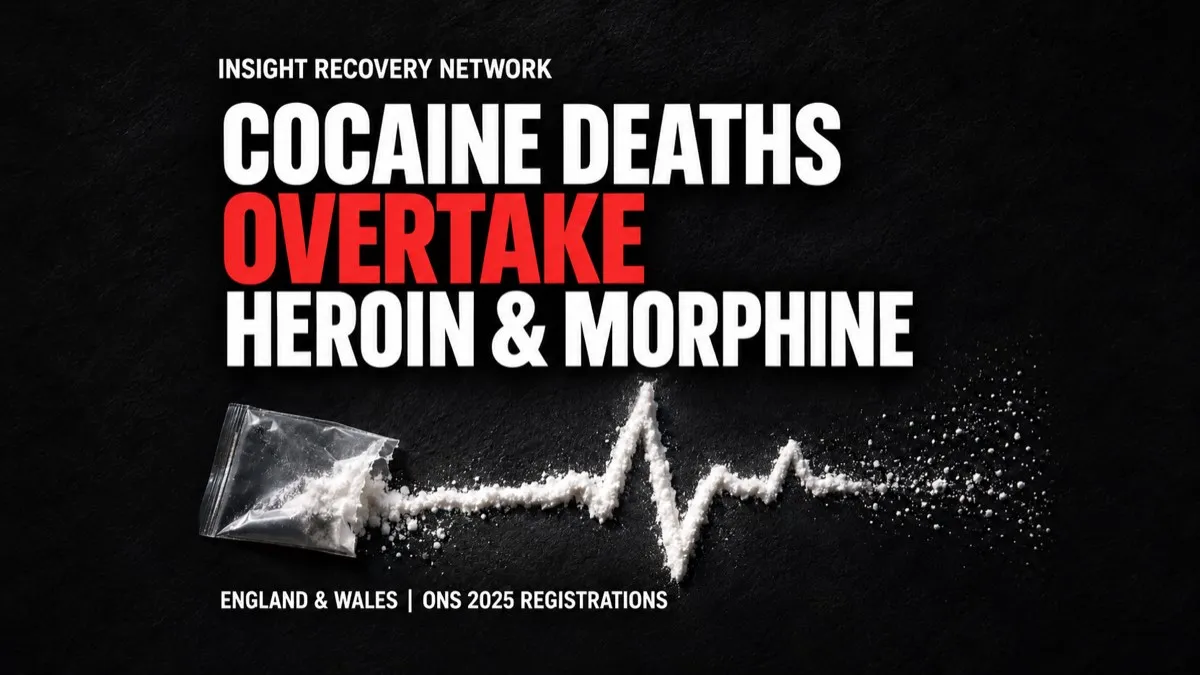
Cocaine has overtaken the combined heroin-or-morphine category in drug-poisoning deaths registered in England and Wales, according to figures published by the Office for National Statistics on 4 November.
There were 1,233 deaths involving cocaine registered in 2025, compared with 1,210 involving heroin or morphine. It is the first time cocaine has led this comparison since the records began in 1993. 1
Want to stop safely?
Talk through the next step with an addiction specialist. Some withdrawal needs medical assessment and supervised detox; Craig can help you find appropriate care.
The detail matters. Cocaine deaths fell from 1,279 in 2024, although they remained more than eight times the 2010 total. Opiates and opioids collectively were still involved in more deaths, at 2,324. These are registrations, not necessarily deaths that occurred during 2025, and more than one substance can be recorded in the same death. 1
The figures do not identify weekend use as the explanation. They do, however, provide a timely reason to challenge an assumption that can prevent people from examining their own use: that something described as a “party drug” belongs in a less serious category of concern.
“I only use at weekends.” “I still get up for work.” “I can afford it.”
Those statements may describe someone’s circumstances accurately. They cannot establish that cocaine is safe for them.
If cocaine use is becoming difficult to control, IRN can discuss structured online support or treatment-placement guidance, depending on your needs and the level of care required.
A functioning life can conceal a growing problem
A person may keep their job, manage their household and maintain an outward appearance of stability while struggling to control their cocaine use.
When someone measures the seriousness of their situation only against a dramatic stereotype of addiction, they can overlook the changes happening closer to home: promises repeatedly broken, money concealed, arguments after nights out, or increasing effort spent arranging the next opportunity to use.
The NHS is clear that daily use is not a requirement for cocaine addiction. Repeatedly trying to cut down or stop without being able to is a reason to seek help. 2
“Functioning” describes what someone is managing to maintain. An assessment needs to examine what using is costing them, how much control they have, and what risks they are taking.
The risks do not wait for dependence
Not everyone who uses cocaine is dependent. Equally, dependence is not a prerequisite for harm. The Royal College of Psychiatrists makes that distinction explicitly. 3
Cocaine can increase heart rate and cause serious physical complications. FRANK warns that even otherwise healthy young people can experience seizures, heart attacks or strokes after using it. Anxiety, paranoia and low mood are also recognised risks. 4
Being employed, physically fit or able to go several days without cocaine does not provide a medical guarantee against those effects.
This is why the conversation needs to include both dependence and immediate risk. Someone can need advice about their cocaine use before they identify with the word “addiction”.
Alcohol changes the picture
Cocaine use also needs to be discussed alongside drinking.
When alcohol and cocaine are used together, the body produces cocaethylene, a toxic substance associated with additional health risks. The Royal College of Psychiatrists warns that the combination increases the risk of seizures and death compared with either substance alone. 3
For someone whose cocaine use happens around drinking, a recovery plan should examine that connection: the first drink, the people and places involved, the point at which intentions change, and what practical support would interrupt the pattern.
Simply promising to “be more sensible next time” leaves too much unexplored.
For suitable adults, IRN’s online recovery programme provides individual sessions and practical recovery planning around patterns like these. Medical concerns still require appropriate clinical care.
Look at the pattern, not just the frequency
Warning signs worth discussing with a professional include cravings, using more than intended, finding it difficult to reduce or stop, and continuing despite harmful consequences. 3
Useful examples to bring to an assessment include:
- Repeatedly exceeding the limits you set before going out.
- Hiding spending or giving misleading accounts of where you have been.
- Losing sleep, missing commitments or becoming less available to your family.
- Continuing after relationship, financial or health concerns have become clear.
- Organising more of your social life around opportunities to use.
These are prompts for an honest conversation, not a checklist that diagnoses someone. You do not need to recognise every example before seeking advice.
For families, start with specific observations and their impact. “I’m worried because you have missed commitments and we keep arguing after nights out” gives a conversation something concrete to address. Choose a time when the person is sober and it is safe to talk. Families can also seek support for themselves.
Support can begin before a crisis
An initial assessment should consider physical and mental health, alcohol and other drug use, previous attempts to stop, and the support available at home.
A GP or local drug treatment service can be a starting point, and people can self-refer to local services. Evidence-based options include cognitive behavioural therapy and incentive-based treatment, often called contingency management. Treatment commonly takes place while someone continues living at home; residential care may be appropriate for more severe or complicated situations. 2
The level of support should follow the person’s needs. Work commitments, privacy and family responsibilities matter, but so does choosing care that can safely address the situation.
A person should not have to lose their job, relationship or home before their concerns are taken seriously. The point of seeking help early is to protect what still matters to them.
Concerned about your own cocaine use or someone else’s?
Insight Recovery Network offers confidential guidance on treatment options, structured online recovery support and family support. Where residential treatment is appropriate, we help people explore suitable options in the UK and abroad. 5
Request a private conversation with Craig.
*For urgent medical help after drug use, call 999 and tell the ambulance team what was taken. IRN is not an emergency service.* 4
Want to stop safely?
Talk through the next step with an addiction specialist. Some withdrawal needs medical assessment and supervised detox; Craig can help you find appropriate care.